Curriculum

1.Improvisation – instrumental and vocal

Course Objective: Learn improvisational concepts with an emphasis on feeling, phrasing, articulation, and melodic as well as harmonic development.

  • Levels one, two and three
  • Theory and ear training – instrumental and vocal

Course Objective: Development of basic aural skills; written and analytical knowledge of simple melody and harmony.

  • Levels one and two

Course Objective: Development of common practice harmonic and formal procedures through written exercises and analysis.

  • Level three
  • Composition

Course Objective: The approach to composition is designed to enable students to discover their creativity in the writing of music. It involves a realization – and use – of understanding musical notation, ability to correctly notate as tools of creation. The class focus, owing to the Camp’s duration, is fixed on providing the student with the experience of completing a short original work – or the opportunity to complete a work already in progress.

2. Ensembles

A. Small Combos – All Levels (Five to Nine Players)
Course Objective: Small group performance techniques including improvisational development, balance, styles, orchestration and compositional development as well as vocals.

B. Big Band – All Levels (Fifteen and above Players)
Course Objective: Students on all instruments and vocals participate collectively in learning varied repertoire and styles; class offers a cohesive approach in learning the nuance of ensemble performance.

C. Vocal Ensemble – All Levels
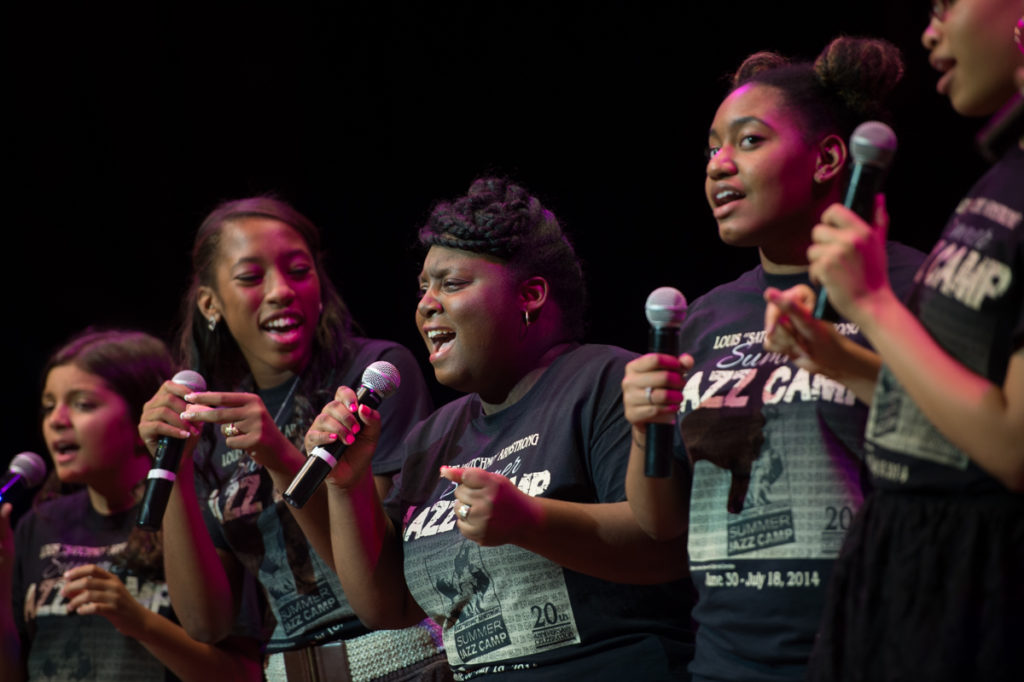
Course Objective: The transference of singing techniques (breath support, resonance, agility, etc.) into effective vocal techniques (i.e., vibrato, phrasing, articulation) that utilizes melodic and harmonic concepts with and without lyrics.

D. Piano Ensembles – All Levels
Course Objective: Students of all levels on piano will be able to play two note voicings, left hand voicings, as well as interpret chord progressions.

E. Woodwinds and Brass – All Levels
Course Objective: The woodwind and brass classes provide students with daily master class experience through the rehearsal and performance of standard and contemporary literature and practice techniques.

F. Percussion – All Levels
Course Objective: Students will learn the language/techniques associated with various styles of jazz drumming (i.e., swing, Latin, bossa nova, New Orleans style, etc.), as well as the drummer’s role in performing within a rhythm section.

G. Acoustic/ Electric Bass
Course Objective: Students study practical approaches in understanding harmony, constructing bass lines, understanding chord symbols, as well as basic bass techniques. Great emphasis is placed on the role of the bass in the rhythm section.

3. Artist-in-Residence/Master Classes and History

A. Artist-in-Residence
Course Objective: Students work with a Master Artist in jazz in various ensemble settings, workshops/clinics, as well as individually. The object of the classes are to enhance from a pedagogical perspective the student’s relationship to his/her instrument in various performance settings.

B. Master Classes/History
Course Objective: Students are taught the cultural and aesthetic importance of Jazz to the development of American Music and World Culture.  Methods used include clinicians, staff, guest artists, film, recordings, lectures and demonstrations.

Swing Dance Curriculum:

I) Excellence & Merit

a) Two week residency in dance
b) Daily classes in Jazz Dance from a musical and movement perspective.

1) Body Discovery – isolated movement of body parts to musical timing and phrasing.

2) Movement studies exploring the physical style of Jazz through choreographed combinations and improvisational studies built on themes and variations.

II) Learning three different styles of Jazz Movement as it connects to the corresponding music and the life conditions in America during its peak.

a) Dancing – Daily classes
b) Lectures and audio/visual support – oral traditions, Video, DVD, Listening
c) Performance preparation – Memorizing sequential steps, staging and cues

III. General Organization: Visibility of curriculum expansion while staying inside the camp’s focus and musical goals.

IV. Community Involvement – Local elders who danced in their younger days share experiences with students through story telling, demonstrations, oaching students through specialized steps and a discussion of social and cultural conditions.

Summary:

1) Course is focused on music students learning movements that relate to the music they are studying. Dance students will be included in the same class to expand their ability for style variations, leadership training, learning improvisational skills and learning how to partner-dance, a traditional Jazz dance form (Lindy Hop).

2) Expressing movement in musical forms, (example; AABA & 12 Bar Blues)

3) Learning standard jazz movements that were developed or peaked with the music. Example; Lindy Hop——-Big Band, Jump for Joy——Hambone Rhythms, Improvisations of colors outside of time———Loft Era.

4) Development of a performance piece using the music of Louis Armstrong.

a) Musical formed structure

b) Working as a collective unit.

c) Learning to partner, to lead and follow another person while moving.

d) Self-expression through designed improvisation constructed inside the choreography.

5) Basic dance skills will be taught and learned during this residency, Examples are; coordination, musicality, moving in space, unison movement, self- expression, cooperation, moving on different levels, changing directions within timing.

Music Production Workshops Are Presently Discontinued

4. Music Production/ Engineering Workshop

A. Audio Recording I
Course Objective: This workshop provides advanced students with a basic understanding of the art and science of audio recording and an introduction to the state-of-the art Digi-design Pro Tools TDM recording system.

B. Audio Recording II
Course Objective: This workshop is to help students who have completed Audio Recording I to develop an understanding of advanced audio production techniques. The focus of this class will be on advanced audio editing, mixing, and mastering. There will also be instruction on the preparation of audio for Internet distribution.

Music Business Workshops Are Presently Discontinued

5. Musicians Music Business Workshop

Course Objective: This workshop provides advanced students with information that they will need to function as writers, composers, performing artists and band leaders within the music and entertainment industries

  • Intellectual Properties
  • Contracts and Fee Agreements
  • Managing and Booking Bands

Comments are closed.